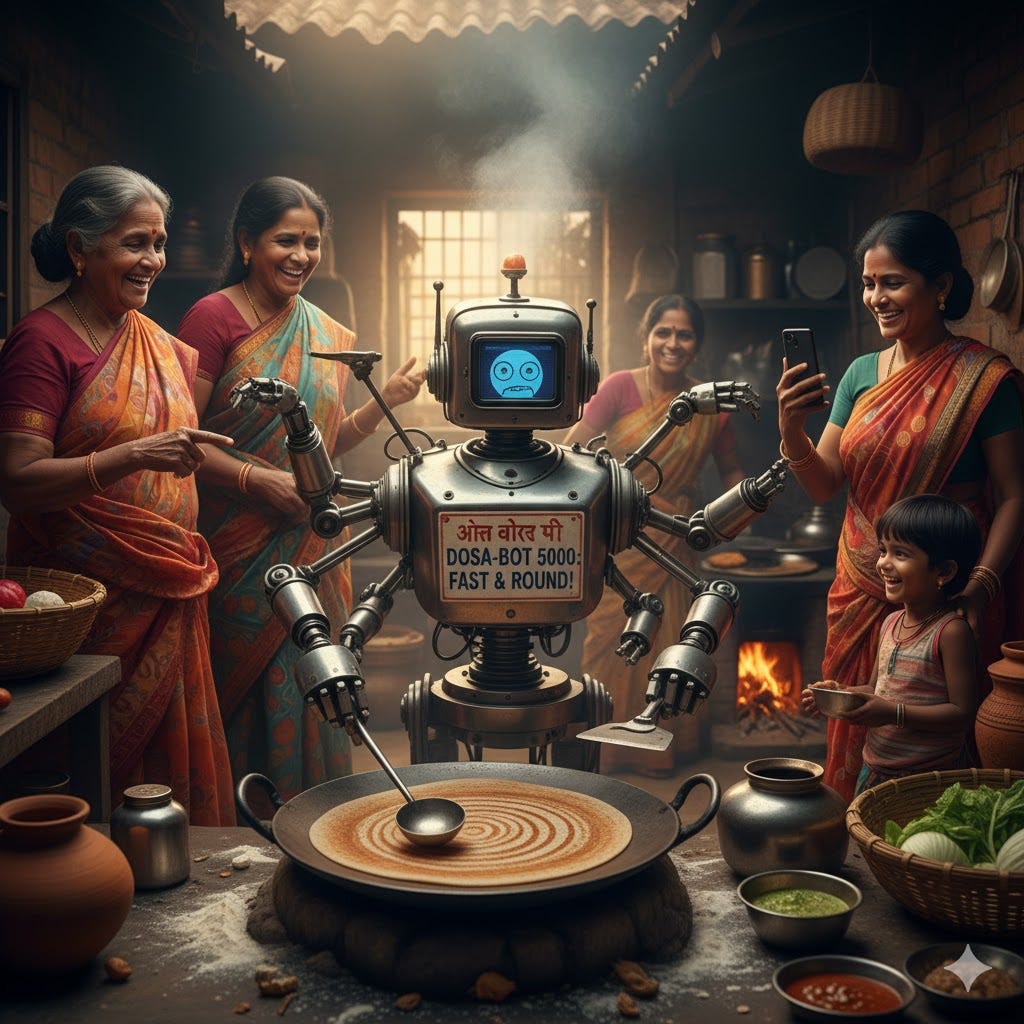
Bots for Bharat
India’s Real AI Opportunity

It’s nearly impossible to have a conversation about India and artificial intelligence without running into one of two familiar refrains. The first is that there are more Indians in the Bay Area building AI than there are in India building for India. The second is the pervasive: when is India’s “DeepSeek moment?”—a canonical yet elusive breakthrough that will (theoretically) cement the nation’s place in the AI race.
When I hear these, I wonder if the entire premise is misplaced. National pride aside, does it matter if the next great large AI model comes from Pune or Palo Alto? Sure, the former would be gratifying, but isn’t India’s most consequential and life-altering opportunity not in training massive models but in absorbing intelligence into the everyday lives of its 65 million small businesses—kiranas, workshops, traders, manufacturers, tailors, and countless others? Into the 150 million small farmers and cooperatives that would benefit from better access to weather, crop, soil, and livestock agents? Do they need the world’s most cutting-edge model, or something more practical: tools that make their purchasing decisions, cash flows, and sales opportunities sharper?
I recently debated this with my old friend Jasminder (Jas) Singh Gulati, whom I talk to regularly. He has been thinking about small business enablement far longer than most people I know. Years ago he built NowFloats as a turnkey way to give tiny shops a digital storefront, which Reliance Jio eventually acquired. Today Jas is deep into his long-running Digital Desh, an ongoing road journey into India’s heartland, listening to how people adopt technology, what enables and prohibits them, and what unlocks trust.
Our conversations wander from big themes—how UPI changed the arc of payments, how Aadhaar and KYC rails gave even the smallest merchants a digital foundation—to the small, lived, daily frictions he hears in taluks across Jharkhand. Shopkeepers running both digital and paper khatas side by side. Exporters stitching linens for overseas buyers who can accept foreign payments but can’t get a local bank to provide working capital. We have debated at length whether the transformative moves in India’s digital history were about invention or distribution and trust. Aadhaar, UPI, the India Stack weren’t necessarily deep-tech marvels by Valley standards, but they reshaped the country because of scale and reliability. And WhatsApp, not of Indian origin at all, became the operating system of commerce because it fit into existing habits.
So when the “Where is our DeepSeek moment?” question arises, we both tend to shrug. Maybe the better question is how to make AI feel like UPI or WhatsApp: invisible infrastructure that works in small, but familiar and obvious ways. Not an abstract breakthrough but a practical nudge that millions can use right now.
To borrow a term from other walks of Indian life, you can call it sacheted AI. India taught the world about the sachet, first with FMCG goods like shampoo, powders, and snacks, and then extended it to data, insurance, and anything small and affordable enough to try. Why shouldn’t intelligence come the same way? Small and contextual. A kirana store could have an agent that looks at its UPI inflows and whispers what to reorder before stockouts. A textile cluster could run a model tuned to shipping delays and overseas demand so a factory can take or decline an export order accordingly. A dairy farmer could get crop and price forecasts tied to weather and mandi data via a WhatsApp ping. None of this needs a giant, headline-making model. It needs local training data, clever packaging, and distribution along rails already built.
India is unusually well placed to do this. Because of UPI, nearly every merchant now has a digital footprint. Aadhaar simplified identity and onboarding while WhatsApp normalized conversational interfaces, while affordable smartphones and ubiquitous 4G did the rest. The next wave can build directly on rails people trust.
However, if the first wave of AI tools in India is locked inside walled gardens of a few platforms, we end up swapping one set of middlemen for another. If interfaces remain English-first or clunky, adoption will stall at the periphery. If privacy and data control are ignored, trust will evaporate. And as always, early adopters could cluster in the urban, English-speaking tier, leaving the vast majority of the country behind.
That said, it feels like time. In Jas’s latest Digital Desh work he writes about tiny merchants in Bihar who now see a smartphone as a ledger, a catalogue, a bank terminal. They already run order books on WhatsApp and collect via QR. They don’t need convincing that digital matters; they need help making better decisions with the data they’re generating.
What could help accelerate this shift? A few things: open APIs so anyone can plug lightweight models into payments and chat; local datasets that let models speak Marathi, Bhojpuri, Kodava; financing that rewards productive digital behavior (if your AI improves your cash flow, your working capital gets cheaper); above all, simple, human interfaces that make intuitive sense.
The prize isn’t a single eureka moment but something quieter: productivity gains diffused through millions of small nodes. A pharmacy shop that reorders smarter, a weaver who exports with more confidence, a food stall that manages seasonal demand. Global conversations about AI love clear symbols—“build our own GPT,” “outcompete DeepMind.” But India’s opportunity is significantly more interesting and profound. As it has done for centuries, India absorbs, adapts, and scales what matters. The country’s digital rails are already a kind of national unfair advantage. They can let intelligence seep down into the base of the pyramid faster than almost anywhere else.
When I talk to Jas about this, I’m reminded how unglamorous true change can look at first. UPI didn’t feel revolutionary in its first months. WhatsApp didn’t feel like infrastructure until suddenly every business depended on it. AI in India might arrive the same way: not with fanfare, but as a quiet new normal.